


From AI Potential Through AI Use Cases to a Robust Management Decision
Updated: 1 day ago
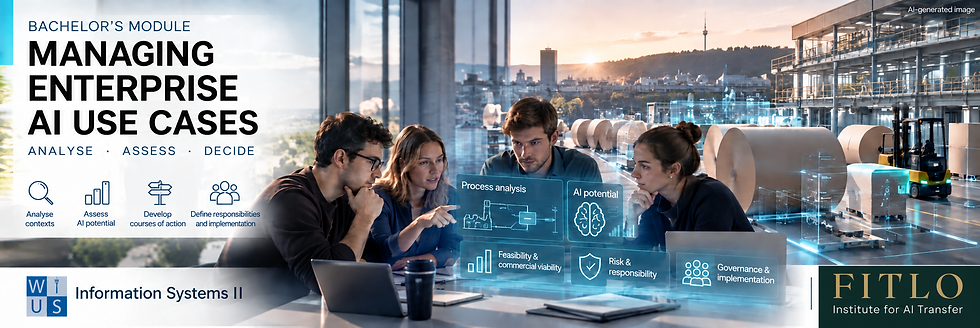
During the 2026/27 winter semester, FITLO | Institute for AI Transfer is supporting the Bachelor’s elective “Managing Enterprise AI Use Cases” at the Chair of Information Systems II at the University of Stuttgart. Working with Klingele Paper & Packaging Group as the industry partner, students assess real and practice-validated AI use cases and develop evidence-based go, no-go or modification recommendations.
Identifying AI use cases is not enough
Many organisations now generate numerous ideas for applying artificial intelligence. The greater challenge is often no longer identifying potential use cases. It is selecting the initiatives that are technically feasible, organisationally implementable, regulatorily responsible and economically viable.
For AI initiatives, an appealing value proposition or convincing demonstrator is not sufficient. A robust decision must also consider questions such as:
Which business problem should the initiative solve?
Which data are available, and what is their quality?
Can the proposed AI function be implemented technically?
How can the solution be integrated into processes and existing systems?
Which legal, ethical and organisational requirements must be addressed?
Which economic, environmental and social effects can be expected?
Which responsibilities and competencies are required for implementation and operation?
The new teaching format addresses this decision gap.
A collaboration between university, industry and FITLO
The module is offered by the Chair of Information Systems II within the Institute of Business Administration at the University of Stuttgart. As a teaching partner, FITLO contributes current research, methodological approaches and experience from organisational AI initiatives.
Klingele Paper & Packaging Group provides the industrial context. Rather than working with abstract textbook examples, the student teams examine real or practice-validated challenges drawn from business processes.
Potential case areas include:
AI-supported processing of customer enquiries and quotations
production planning and sequence optimisation
customer intelligence and next best action in sales
energy forecasting and energy-efficient production
quality and root-cause analysis
AI assistance for packaging development and material optimisation
The cases are deliberately not fully predefined. Students must distinguish between available evidence, plausible assumptions and unresolved information needs. Missing information is not replaced with speculation. Instead, it is translated into focused requests for information addressed to the industry partner.
Eight steps from business context to recommendation
At the centre of the module is an eight-step assessment method. It guides the teams systematically from the initial business context to a documented management recommendation.
1. Clarify scope, context and the reference process
The teams formulate the decision question, define system boundaries and analyse the technical, organisational and regulatory context. They document the existing process and relevant baseline metrics for later comparison.
2. Identify and describe AI use cases
Potential AI applications are derived from process problems and pain points. Students distinguish between the business problem, the technical solution and the relevant type of AI task.
3. Define the assessment framework
The teams develop a case-specific set of assessment criteria and weight them according to organisational objectives and the decision context.
4. Preselect AI use cases
Potential applications are made comparable and narrowed down to a reasoned selection.
5. Assess AI suitability
The selected use cases are evaluated from technical, organisational and regulatory perspectives. The assessment considers factors such as data availability, system integration, governance, compliance and operational feasibility.
6. Assess AI impact
Expected effects are assessed not only economically but also environmentally and socially. The analysis therefore extends beyond a conventional business case.
7. Aggregate and prioritise the results
The individual assessments are combined into a transparent overall evaluation and a prioritised portfolio of use cases.
8. Derive and validate a recommendation
The teams formulate an evidence-based go, no-go or modification recommendation. They also identify unresolved requirements, risks and appropriate next steps.
Different roles create different perspectives
The group work incorporates the AI role-unit model developed by Dr Florian Härer and supplements it with a facilitation role. All team members contribute to every assessment step, but they examine it from different perspectives:
The Orchestrator represents the strategic and economic perspective, assesses viability and prioritises initiatives.
The Deliverer examines technical feasibility, data availability and possible solution approaches.
The Enabler considers organisational conditions, governance, compliance and future operations.
The Connector addresses environmental and social effects as well as questions of acceptance.
The Facilitator structures the assessment process, moderates the group and coordinates its documentation.
Students therefore experience that a robust AI decision cannot emerge from a single professional perspective. Technical, economic, organisational, regulatory and social assessments must be brought together.
Case-based learning throughout the semester
The teaching format connects academic input directly with its application to a semester-long group case. A kick-off is followed by ten combined lecture and exercise sessions. Each new concept is applied immediately to the respective business case.
The teams document their work in three consecutive stages:
Preparation and scoping
Assessment of AI suitability and impact
Recommendation and implementation
The groups receive formative feedback throughout the semester. Individual achievement is assessed through a 90-minute written examination in which students apply the assessment logic to a new business context.
What students gain from the module
By the end of the module, students will be able to:
systematically identify and define enterprise AI use cases,
analyse the decision context and relevant stakeholders,
assess technical, organisational and regulatory suitability,
evaluate economic, environmental and social effects,
distinguish evidence from assumptions and information gaps,
combine multiple assessment dimensions into a transparent decision,
and present evidence-based recommendations to management and industry partners.
The module therefore teaches more than knowledge about artificial intelligence. It develops the ability to prepare structured and responsible management decisions under conditions of incomplete information.
AI Transfer in university teaching
The collaboration demonstrates what FITLO means by AI Transfer. Research findings and methodological approaches are not merely presented. They are applied to concrete challenges from organisational practice.
At the same time, the project generates new insights into how AI use cases can be assessed systematically, how responsibilities can be structured and how different professional perspectives can be integrated into a shared decision-making process.
The module brings together three elements:
Research foundations, real organisational challenges and the development of future specialists and leaders.
The module is taught by Professor Dr Georg Herzwurm, Dr Florian Härer, Dr Dimitri Petrik and Sarah Merz. FITLO looks forward to working with the students, the University of Stuttgart and Klingele Paper & Packaging Group, and to the recommendations that will emerge over the course of the semester.


